Titelaufnahme
Titelaufnahme
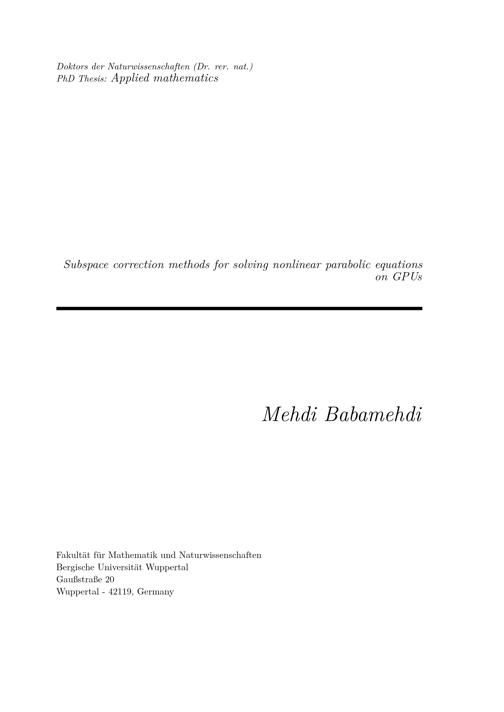
- TitelSubspace correction methods for solving nonlinear parabolic equations on GPUs / Mehdi Babamehdi
- Verfasser
- Gutachter
- Erschienen
- Umfang1 Online-Ressource (e, x, 85, A2 Seiten)
- HochschulschriftBergische Universität Wuppertal, Dissertation, 2026
- Verteidigung2026-07-08
- SpracheEnglisch
- DokumenttypDissertation
- Schlagwörter
- URN
- DOI
Zugriffsbeschränkung
- Das Dokument ist frei verfügbar
Links
- Social MediaShare
- Nachweis
- Archiv
- IIIF
Download
Klassifikation
Abstract
Nonlinear problems are often more challenging to solve than linear ones because they may involve non-convexity, heterogeneity, and strong nonlinearities. These difficulties are compounded in modern high-performance computing systems, where algorithms must efficiently exploit heterogeneous architectures combining CPUs and multiple GPUs. Developing nonlinear solvers that address both the mathematical and computational challenges is therefore important. This thesis develops and analyzes multilevel nonlinear methods for the numerical solution of the Allen–Cahn equation, with an emphasis on matrix-free implementation on graphics processing units (GPUs). The full approximation scheme (FAS) serves as the nonlinear multigrid solver, while the nonlinear restricted additive Schwarz method (NRASM) is used as a smoother in the FAS-NRASM algorithm. I prove that NRASM satisfies the smoothing condition required by FAS. Numerical results show that, for the strategy considered, the number of FAS V-cycles required to solve the discretized Allen–Cahn equation is independent of problem size. Because standard FAS relies on convexity, this requirement can constrain the time-step size. To address more nonlinear and non-convex problems, I analyze FAS as a multilevel optimization algorithm and NRASM as a minimization method. This analysis motivates the NE-FAS-NRAM algorithm, which uses NRASM as a preconditioner-smoother. Theoretical analysis and numerical experiments demonstrate that the method can solve non-convex, highly nonlinear problems and allows time steps approximately 400 times larger than in the convex case considered. It converges for a moderate range of random initial guesses, although it may fail for very poor initial guesses. In GPU experiments on the Allen–Cahn equation, the new algorithm achieved a reported speed-up of 40,000× in convergence compared with solving the equation on a CPU using the FAS-NRASM algorithm.
Inhalt
Statistik
- Das PDF-Dokument wurde 6 mal heruntergeladen.
Lizenz-/Rechtehinweis
