
Bibliographic Metadata
Bibliographic Metadata
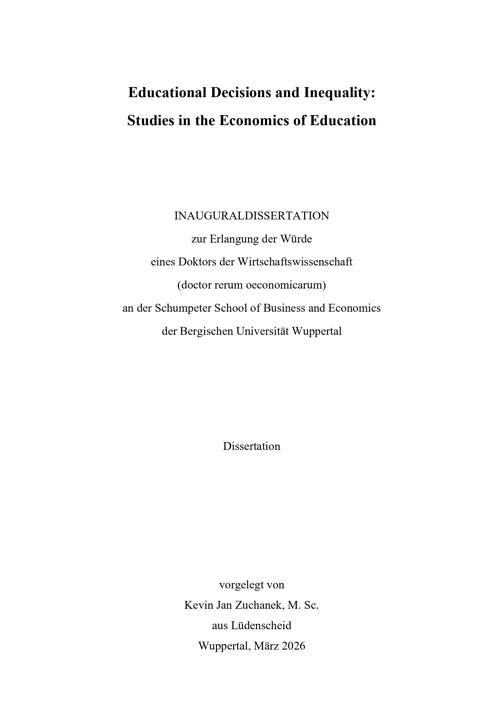
- TitleEducational decisions and inequality: Studies in the economics of education / vorgelegt von Kevin Jan Zuchanek, M.Sc.
- Author
- Degree supervisor
- Published
- Description1 Online-Ressource (125 Seiten)
- Institutional NoteBergische Universität Wuppertal, Dissertation, 2026
- Defended on2026-09-22
- LanguageEnglish
- Document typeDissertation (PhD)
- Topics
- URN
- DOI
Restriction-Information
- The document is publicly available on the WWW
Links
- Social MediaShare
- Reference
- Archive
- IIIF
Classification
Abstract
Education can promote social mobility, yet the opportunities to invest in education are unequally distributed. This dissertation examines how constraints on educational decision-making shape educational opportunities and inequalities across two contrasting settings: Bremen, Germany, and Beirut, Lebanon. It brings together three empirical studies on school assignment, access to information, and household responses to a severe shock.The first study uses random tie-breaking in Bremen’s secondary school assignment system to examine the consequences of losing an admission lottery. Lottery losses lead to longer journeys to school, disrupted peer networks, and changes in school composition. The study finds no consistent overall academic disadvantage, but shows that exposure to lottery losses and the ability to respond by attending a private school differ across student groups.The second study evaluates the introduction of school assignment information in six additional languages. Using a difference-in-differences design, it finds that students whose home language was covered by the translations became more likely to rank and attend an academic secondary school. This suggests that language barriers can affect consequential choices even within a formally fair and standardised assignment system.The third study examines the effects of the 2020 Beirut Port Explosion on Syrian refugee households. Difference-in-differences estimates indicate worsening material conditions and greater reliance on coping strategies, alongside lower school attendance, increased child labour, and greater exposure to violence among children. Early marriage also increases among young teenage girls. These findings show how a shock can place the burden of household adjustment on children when resources and institutional protection are limited.Together, the studies demonstrate that educational equity depends not only on formal access to education, but also on families’ access to information, viable choices, and support when shocks threaten educational investment.
Content
Stats
- The PDF-Document has been downloaded 32 times.
License/Rightsstatement
