
Titelaufnahme
Titelaufnahme
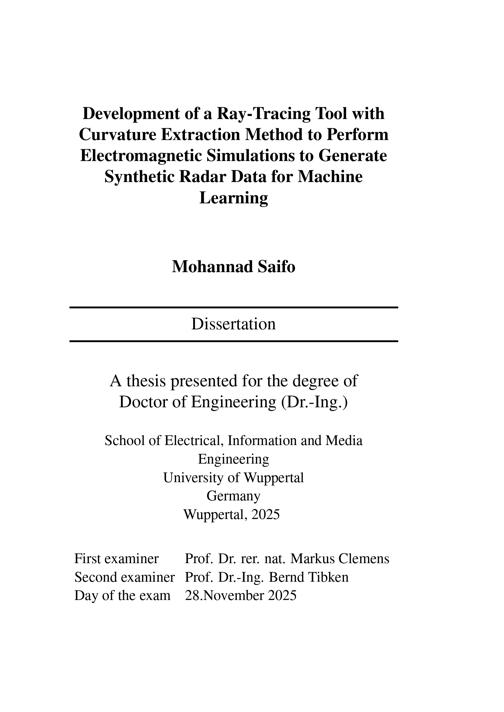
- TitelDevelopment of a ray-tracing tool with curvature extraction method to perform electromagnetic simulations to generate synthetic radar data for machine learning / Mohannad Saifo
- Verfasser
- Erschienen
- Umfang1 Online-Ressource (x, 146 Seiten) : Illustrationen, Diagramme
- HochschulschriftBergische Universität Wuppertal, Dissertation, 2025
- Verteidigung2025-11-28
- SpracheEnglisch
- DokumenttypDissertation
- Institution
- Schlagwörter
- URN
- DOI
Zugriffsbeschränkung
- Das Dokument ist frei verfügbar
Links
- Social MediaShare
- Nachweis
- Archiv
- IIIF
Download
Klassifikation
Abstract
The radar (radio detection and ranging) sensor is increasingly used in the automotive industry for sensing the environment of a car with its ability to detect a target's location and radial velocity with good precision. It is used for driver assistance features, increasing safety and enhancing driving experience, and is under development to be used for autonomous driving. Driver assistance features include: adaptive cruise control (ACC), blind spot monitoring (BSM), and automatic emergency braking (AEB). Developing these algorithms requires a large amount of data for tuning and validation, especially when utilizing machine learning techniques, which are used evermore for functions like object recognition and environment perception. To generate this data, either a measurement campaign should be undertaken or simulation techniques can be utilized. Several simulation methods are available like the finite element method (FEM), method of moments (MOM), or the physical optics method (PO). For large scenes, it is impossible to use the first two because they are full wave methods and very computationally expensive. Therefore, asymptotic methods are more suitable for this purpose. In this work, a simulation tool is built using the programming language C++ with a modified version of PO called the modified equivalent current approximation (MECA) along with geometrical optics (GO) to account for the multi-bounce effect. In driving scenarios, the objects are on the ground, which causes what is called the multi-path effect. Accounting for this phenomenon by including the ground in the simulation leads to a very long run time. Therefore, the multi-path effect is implemented by assuming a virtual ground and mirroring the antenna with respect to the ground. A problem arises when simulating objects with curved surfaces due to the process of converting the object into a mesh of flat triangular facets, leading to error in the resulting RCS because of the deviation between the actual curved surface and the flat facets representing it. A study on this effect is conducted, quantifying the error with respect to the maximum surface deviation defined when meshing the object, and two solutions are suggested. The first one is to mesh the object with a specific maximum surface deviation which generates suitable mesh and accurate results. The second one is used especially when the original CAD file of the object is not available but only the triangle-based mesh, which is to estimate the curvature from the triangular mesh and then find the intersection point and the normal using our suggested method, which resulted in much better results.To generate results in close to real-time speed, it is proposed to use a representation of the target by a point scattering center with an RCS map in two dimensions: angle and range. Then the multi-path effect is applied using the four-path model in Matlab, which is much faster than including the ground in the simulation.Lastly, one effect of the fascia of the car on the radar signal is studied, which is the ghost targets resulting from the reflection of the transmitted signal off the internal surface of the fascia and metal structure of the car.
Statistik
- Das PDF-Dokument wurde 26 mal heruntergeladen.
