
Titelaufnahme
Titelaufnahme
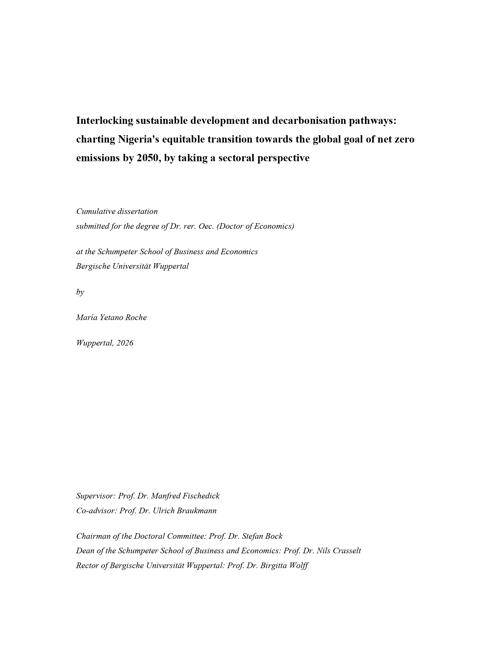
- TitelInterlocking sustainable development and decarbonisation pathways: charting Nigeria's equitable transition towards the global goal of net zero emissions by 2050, by taking a sectoral perspective / by María Yetano Roche
- Verfasser
- Gutachter
- Erschienen
- Umfang1 Online-Ressource (X, 97 Seiten, 51 verschieden gezählte Seiten) : Illustrationen
- HochschulschriftBergische Universität Wuppertal, Dissertation, 2026
- AnmerkungKumulative Dissertation
- Verteidigung2026-01-13
- SpracheEnglisch
- DokumenttypDissertation
- Institution
- SchlagwörterNachhaltige Entwicklung / Nachhaltigkeit / Dekarbonisierung / Nigeria / Energiewende / Elektrizitätszugang / Sauberes Kochen / Zementindustrie / Sozio-technische Transformationen / Klimapolitik / Szenarioanalyse / Klimawandel / Sustainable Development / Sustainability / Decarbonisation / Energy Transition / Electricity Access / Clean Cooking / Cement Industry / Socio-technical Transitions / Climate Policy / Scenario Analysis / Climate Change
- URN
- DOI
Zugriffsbeschränkung
- Das Dokument ist frei verfügbar
Links
- Social MediaShare
- Nachweis
- Archiv
- IIIF
Download
Klassifikation
Zusammenfassung
Diese Dissertation untersucht das Zusammenspiel zwischen nachhaltiger Entwicklung und Dekarbonisierung in Nigeria und konzentriert sich auf Übergangspfade in drei kritischen Wirtschaftssektoren: Elektrizität, Zementproduktion und Kochenergie. An der Schnittstelle von Klimapolitik, Entwicklungsökonomie und sozio-technischer Transitionstheorie angesiedelt, befasst sich die Forschung mit der doppelten Herausforderung, eine gerechte Entwicklung zu erreichen und die globalen Klimaverpflichtungen zu erfüllen. Unter Verwendung einer Mischung aus qualitativen und quantitativen Szenariomethoden bietet diese kumulative Dissertation eine sektorale Perspektive darauf, wie Nigeria - das bis 2050 das drittbevölkerungsreichste Land der Welt werden soll - eine inklusive und gerechte Entwicklung sicherstellen kann, während gleichzeitig dringende Klimaschutzmaßnahmen erforderlich sind. Die Ergebnisse dieser Dissertation zeigen, dass Nigeria seine Ziele für den Stromzugang und die Dekarbonisierung des Stromsektors bis 2030 erreichen kann, indem es netzunabhängige Lösungen für erneuerbare Energien ausbaut, trotz der anhaltenden Dominanz der fossilen Eigenerzeugung. Die Emissionsziele, zu denen sich die nigerianische Regierung in ihrem Nationally Determined Contribution verpflichtet hat, können problemlos erreicht werden, und für künftige Ziele könnte ein höheres Maß an Ehrgeiz gerechtfertigt sein. Im Zementsektor sind zur Erreichung der Dekarbonisierungsziele Innovationen in den Bereichen Energieeffizienz, Verringerung des Klinker-Zement-Verhältnisses und Nachfragesteuerung erforderlich. Es ist unwahrscheinlich, dass die Dekarbonisierungspfade im Zementsektor mit dem erklärten Ziel Nigerias vereinbar sind, bis Mitte des Jahrhunderts Netto-Null-Emissionen in diesem Sektor zu erreichen. Ein optimaler Übergangspfad würde den Sektor jedoch auf Kurs bringen, um die Netto-Null-Emissionsziele später in diesem Jahrhundert zu erreichen. Bei sauberer Kochenergie hängt der Übergang davon ab, dass sauberere Brennstoffe wie Flüssiggas und Elektrizität auf breiter Basis eingeführt werden. Ein plausibler, aber sehr schneller Übergang kann die Ziele der Regierung in Bezug auf den Zugang und die Dekarbonisierung des Kochenergiesektors bis 2050 erreichen und gleichzeitig eine absolute Reduzierung der jährlichen vorzeitigen Todesfälle aufgrund von Luftverschmutzung in Haushalten bewirken. In allen Sektoren unterstreicht die Studie die entscheidende Rolle von politischen Maßnahmen und Investitionen, um transformative Veränderungen voranzutreiben, sowie die Bedeutung des Managements und des Schutzes von Nischeninnovationen. Ein wichtiger Beitrag dieser Arbeit liegt in ihrem methodischen Ansatz, der quantitative Szenarioanalysen mit der Einbindung von Stakeholdern kombiniert, um machbare Transformationspfade unter datenarmen Bedingungen besser untersuchen zu können. Die Ergebnisse beleuchten kritische Unsicherheiten - von makroökonomischen Schocks bis hin zur Dynamik der Nachfrage nach Strom oder Zement - und unterstreichen die Notwendigkeit einer adaptiven Planung, um diese Herausforderungen zu bewältigen.
Abstract
This thesis examines the interplay between sustainable development and decarbonisation in Nigeria, focusing on transition pathways in three critical economic sectors: electricity, cement production, and cooking energy. Positioned at the nexus of climate policy, development economics and socio-technical transition theory, the research addresses the dual challenge of achieving equitable development and meeting global climate commitments. Using a mix of qualitative and quantitative scenario methods, this cumulative thesis provides a sectoral perspective on how Nigeria – set to become the world’s third most populous country by 2050 – can ensure inclusive and equitable development amidst the need for urgent climate action. The findings of this thesis reveal that Nigeria can meet its electricity access goals and decarbonisation pledges for the power sector by 2030 by scaling up off-grid renewable solutions and despite the continued dominance of fossil-based self-generation. The emission goals that the Nigerian government committed to in its Nationally Determined Contribution can be comfortably met, and a higher level of ambition may be warranted in future goals. In the cement sector, meeting decarbonisation targets will require innovation in energy efficiency, reduced clinker-to-cement ratios, and demand management. Decarbonisation pathways in the cement sector are unlikely to be consistent with Nigeria's stated goal of achieving net zero emissions in the sector by mid-century. However, an optimal transition pathway would set the sector on course to meet net zero goals later in the century. For clean cooking energy, the transition depends on enabling the widespread adoption of cleaner fuels such as liquefied petroleum gas and electricity. A plausible but very rapid transition can deliver the government's access and decarbonisation objectives for the cooking energy sector by 2050, while also achieving an absolute reduction in annual premature deaths from exposure to household air pollution. Across all sectors, the research underscores the critical role of enabling policy and investment in driving transformative change, as well as the importance of managing and protecting niche innovations. A key contribution of this thesis lies in its methodological approach, which combines quantitative scenario analyses with stakeholder engagement to better explore feasible transition trajectories under data-scarce conditions. The findings shed light on critical uncertainties—ranging from macro-economic shocks to the dynamics of demand for electricity or cement —and emphasise the need for adaptive planning to address these challenges. By synthesising empirical findings with the socio-technical transitions framework, this thesis contributes to advancing the theory and empirical study of sustainability transitions in the global south. It highlights the unique dynamics of transitions in developing economies, including informal institutions, sectoral disparities, and socio-economic trade-offs. In addition to theoretical contributions, the thesis provides actionable insights for policymakers, private sector actors, and development practitioners. It emphasizes the need for sector-specific strategies that address governance gaps, reduce investment risks, and balance decarbonisation with inclusive sustainable development. The findings demonstrate how Nigeria, one of Africa's largest economies and a key player in global climate governance, can achieve its development objectives while being consistent with its own decarbonisation targets and the world’s need to reach net zero emissions by 2050. Ultimately, the thesis deepens the understanding of pathways to sustainable development in developing and emerging economies that are aligned with global climate goals.
Inhalt
Statistik
- Das PDF-Dokument wurde 82 mal heruntergeladen.
Lizenz-/Rechtehinweis
